I was sitting at my favorite European street cafe today and realized it’s been ten years since launching this blog. Back then I struggled to identify the predominant themes around the Art of Wondering – my attempt to live an enriched life in a mundane world. How should that effort be described? What should be the main categories for the blog to best capture the disparate interests and passions in their entirety? I landed on the following (in no particular order) – and at the time did my best to post a description of what each encompasses:
- Knowledge Adventuring
- Beauty & Aesthetics
- Creating & Building
- Liberty & Empowerment
- Enriched Living
I decided to do a quick check today of how search engines and AI respond when queried for Art Of Wondering. Some interesting results were returned, but the most impressive was ChatGPT. It pretty much blew me away. So, I share here the interaction below.
[And, just kidding….I’m not at a European street cafe; instead at one of my regular lunchtime restaurant haunts.]
🙂
What is the Art of Wondering?
If you’re using “The Art of Wondering” as a concept rather than referring to a specific book, it captures an important idea that appears throughout philosophy, science, and creativity: the disciplined practice of asking meaningful questions before rushing to answers.
The art of wondering involves habits such as:
- Suspending certainty instead of immediately forming conclusions.
- Observing deeply, noticing details that others overlook.
- Asking “Why?” and “What if?” repeatedly to uncover underlying principles.
- Remaining intellectually humble, recognizing that every answer often leads to better questions.
- Embracing curiosity as a lifelong skill rather than something reserved for childhood.
Many of history’s greatest thinkers treated wonder as the beginning of wisdom. Classical philosophers described philosophy itself as beginning in wonder, while modern scientists often credit curiosity—not certainty—as the engine of discovery.
Wondering can also be practiced intentionally. For example:
- Spend several minutes observing a familiar object as if you’ve never seen it before.
- When presented with a claim, ask:
- How do we know this is true?
- What evidence supports it?
- Could there be another explanation?
- Read viewpoints that challenge your assumptions.
- Replace the desire to be right with the desire to understand.
Interestingly, research on experiences of awe and wonder suggests that slowing down, paying sustained attention, and engaging deeply with art or nature can increase curiosity, compassion, and well-being.
Given the themes you’ve explored previously—questioning assumptions, seeking objective reality, and breaking free from inherited beliefs—the phrase “The Art of Wondering” seems particularly fitting. It emphasizes that genuine understanding often begins not with certainty, but with asking better questions.
One concise way to define it is:
The Art of Wondering is the deliberate practice of questioning appearances, seeking deeper understanding, and remaining curious enough to let evidence—not assumptions—shape one’s view of reality.
Bottom of Form
How is the Art of Wondering related to living an Enriched Life?
The art of wondering and an enriched life are closely connected because wonder changes how you experience the world, not just what you know. It transforms ordinary experiences into opportunities for discovery, growth, and meaning.
Here are several ways wonder contributes to a richer life:
Wonder keeps the mind alive
Wonder is the antidote to intellectual stagnation. When you continue asking questions—about nature, history, people, or yourself—you remain a lifelong learner. Instead of feeling that you’ve “figured everything out,” you continually expand your understanding.
Wonder deepens experiences
People often stop noticing what is familiar. Wonder restores attention. A walk through a forest becomes an exploration of ecosystems. A conversation becomes an opportunity to understand another person’s perspective. Even everyday routines can reveal unexpected complexity when viewed with fresh eyes.
Wonder builds wisdom
Knowledge is accumulating facts. Wisdom is understanding how those facts fit together. Wonder encourages you to ask not only What? but also Why?, How?, and What follows from this? Those questions foster deeper insight rather than superficial information.
Wonder encourages humility
The more you genuinely wonder, the more you recognize how much remains unknown. This kind of humility isn’t self-diminishing; it makes you more open to learning, less defensive, and more willing to revise your beliefs when new evidence appears.
Wonder fuels creativity
Many inventions, works of art, and scientific breakthroughs began with simple questions:
- “What if there’s another way?”
- “Why does this happen?”
- “What would happen if…?”
Wonder is often the spark that precedes innovation.
Wonder strengthens relationships
Approaching people with curiosity rather than assumptions leads to deeper conversations and greater empathy. Instead of believing you already know someone’s story, you remain interested in discovering it.
Wonder makes life meaningful
An enriched life isn’t necessarily one filled with more possessions or achievements. It’s one filled with more engagement. Wonder turns life from something to merely get through into something to explore. Whether contemplating the age of the universe, the intricacies of a flower, or the resilience of the human spirit, wonder creates a sense that there is always more to discover.
The cycle of an enriched life
Wonder often creates a positive feedback loop:
- Notice something.
- Become curious about it.
- Investigate and learn.
- Gain understanding.
- Develop appreciation.
- Discover new questions.
- Wonder again.
This cycle never truly ends, and that’s part of what makes it enriching.
A guiding thought
One way to think about it is:
An enriched life is not measured by how many answers you possess, but by the depth of your curiosity, the quality of your questions, and your willingness to remain open to discovery.
In that sense, the art of wondering is less about finding final answers and more about cultivating a way of living—one characterized by curiosity, attentiveness, intellectual honesty, and a continual readiness to discover something new about the world and yourself.
How is the Art of Wondering related to Knowledge Adventuring and Proper Thinking?
The three ideas—The Art of Wondering, Knowledge Adventuring, and Proper Thinking—can be viewed as three stages of a single lifelong process of learning and personal growth. Each depends on the others.
- The Art of Wondering: The Beginning
Wonder is the spark. It is the recognition that there is more to understand than what is immediately apparent.
Wonder asks:
- Why?
- How?
- What if?
- Is this really true?
- What evidence supports this?
- What am I missing?
Without wonder, there is little motivation to seek knowledge. Curiosity is the engine that starts the journey.
- Knowledge Adventuring: The Journey
Wonder naturally leads to exploration.
Knowledge adventuring is the active pursuit of understanding. It means venturing beyond familiar ideas and intentionally exploring new sources of information, experiences, disciplines, and perspectives.
A knowledge adventurer:
- Reads broadly.
- Investigates primary sources.
- Learns from history, science, philosophy, and art.
- Travels mentally or physically.
- Challenges assumptions.
- Welcomes uncertainty as part of discovery.
Like any adventure, there are dead ends, surprises, and unexpected discoveries. The goal isn’t simply to collect facts, but to expand one’s understanding of reality.
- Proper Thinking: The Navigator
If wonder provides the motivation and knowledge adventuring provides the exploration, proper thinking provides the discipline.
Proper thinking includes:
- Logical reasoning
- Critical thinking
- Evidence-based conclusions
- Recognition of cognitive biases
- Intellectual humility
- Consistency
- Willingness to revise beliefs when evidence changes
Proper thinking asks:
- Does this conclusion follow from the evidence?
- Am I confusing opinion with fact?
- Have I considered alternative explanations?
- Is this source reliable?
- What assumptions am I making?
Without proper thinking, a person can collect enormous amounts of information yet still reach poor conclusions.
Together they form a cycle
WONDER
(Ask Questions)
↓
KNOWLEDGE ADVENTURING
(Explore and Discover)
↓
PROPER THINKING
(Evaluate and Integrate)
↓
DEEPER WONDER
(Better Questions)
Each stage strengthens the next:
- Wonder generates questions.
- Knowledge adventuring seeks answers.
- Proper thinking evaluates those answers.
- Better understanding leads to deeper, more sophisticated questions.
The cycle repeats throughout life.
An analogy
Imagine exploring an unknown continent.
- The Art of Wondering is standing on the shoreline and asking, “What lies beyond those mountains?”
- Knowledge Adventuring is packing your supplies and setting out across forests, rivers, and deserts to find out.
- Proper Thinking is using maps, a compass, careful observation, and sound judgment to avoid getting lost or mistaking mirages for reality.
Without wonder, you never leave the shore.
Without adventure, your questions remain unanswered.
Without proper thinking, you may travel extensively but mistake the path, misread the terrain, or draw unreliable conclusions.
A unifying philosophy
Taken together, these ideas describe a coherent approach to lifelong learning:
Wonder awakens curiosity. Knowledge adventuring transforms curiosity into exploration. Proper thinking transforms exploration into understanding. That understanding, in turn, inspires new wonder and begins the cycle again.
Rather than three separate concepts, they can be seen as complementary habits of mind: wonder initiates inquiry, exploration broadens experience, and disciplined thinking helps ensure that what you learn is as accurate and well-founded as possible. This continual cycle encourages both intellectual growth and a deeper appreciation of the complexity of the world.
How is the Art of Wondering related to Beauty & Aesthetics?
The Art of Wondering and beauty and aesthetics are deeply intertwined because beauty often awakens wonder, and wonder allows us to perceive beauty more fully. One opens the door; the other invites us to linger.
Beauty is an invitation to wonder
When we encounter something beautiful—a mountain landscape, a symphony, a mathematical proof, a work of architecture, or a compassionate act—we often pause. That pause interrupts our routines and prompts questions:
- Why does this move me?
- How did this come to be?
- What makes this harmonious?
- What does it reveal about nature, humanity, or myself?
Beauty doesn’t simply please the senses; it often stimulates curiosity.
Wonder deepens aesthetic appreciation
Without wonder, beauty can become ordinary through familiarity. Wonder encourages us to look again and more carefully.
For example:
- A flower becomes more beautiful when you understand its intricate structure and ecological role.
- The night sky becomes more awe-inspiring when you realize you’re seeing light that has traveled for millions of years.
- A piece of music gains richness when you notice recurring themes, harmonies, and emotional progression.
Knowledge doesn’t necessarily diminish beauty; it often enlarges it.
Beauty exists beyond art
Aesthetics is often associated with paintings, music, and sculpture, but wonder reveals beauty in many forms:
- Natural beauty: forests, oceans, galaxies, weather patterns
- Intellectual beauty: elegant scientific theories, logical proofs, ingenious engineering
- Human beauty: kindness, courage, perseverance, wisdom
- Moral beauty: integrity, justice, generosity
- Everyday beauty: craftsmanship, well-designed tools, meaningful conversations, simple moments of peace
The art of wondering broadens our sense of what counts as beautiful.
Beauty encourages attention
Many philosophers and psychologists have noted that beauty draws our attention. Wonder then sustains that attention.
Instead of asking, “Do I like this?” wonder asks:
- What makes this beautiful?
- What patterns am I noticing?
- What story does this tell?
- Why has this endured across generations?
This shift turns passive enjoyment into active appreciation.
Wonder nurtures creativity
Artists, architects, scientists, and inventors often begin with wonder. They ask:
- Could this be expressed differently?
- Is there a more elegant solution?
- What if beauty and function worked together?
Many creative breakthroughs arise from the meeting of curiosity and aesthetic sensitivity.
Beauty enriches the search for truth
Beauty and truth are not identical, and beautiful ideas can still be false. Yet many thinkers have observed that elegance, simplicity, and coherence can guide inquiry when paired with evidence and critical thinking.
Wonder helps keep this balance. It appreciates beauty while remaining willing to ask:
- Is this actually true?
- Does the evidence support it?
- Am I being persuaded by appearance alone?
In this way, wonder allows beauty to inspire inquiry without replacing careful judgment.
A relationship of mutual reinforcement
You can think of the relationship like this:
Beauty
↓
Captures attention
↓
Wonder awakens
↓
Questions arise
↓
Exploration begins
↓
Understanding grows
↓
Beauty becomes even deeper
The cycle continues because greater understanding often reveals layers of beauty that were previously invisible.
A unifying perspective
Together, these ideas suggest that beauty and aesthetics are not merely about decoration or pleasure—they are ways of engaging more deeply with reality. Beauty draws us in; wonder keeps us engaged. As we explore, our appreciation becomes more informed and more nuanced.
One way to summarize the relationship is:
Beauty awakens the desire to look. The Art of Wondering teaches us how to keep looking—until admiration becomes understanding, and understanding reveals even greater beauty.
How is the Art of Wondering related to Creating and Building?
The Art of Wondering and Creating and Building are connected because every meaningful creation begins with someone imagining that reality could be different from what it is today. Wonder is the seed; creation is the flowering of that seed.
Wonder asks, “What could be?” Creating and building answer, “Let’s find out.”
Wonder is the origin of creation
Every invention, building, work of art, scientific theory, or business began with a question.
- What if there were a better way?
- Why does this problem exist?
- Could this be simpler?
- What hasn’t anyone tried yet?
Wonder transforms dissatisfaction with the status quo into curiosity about possibilities.
Without wonder, creation often becomes imitation.
Wonder expands imagination
The act of wondering encourages us to think beyond existing solutions.
Rather than asking:
“What already exists?”
Wonder asks:
“What could exist?”
This shift enables innovation because it loosens the grip of assumptions and opens the mind to alternatives.
Creating is thinking made visible
Creating is more than making objects. It is giving form to ideas.
A creator moves through a sequence like this:
- Notice something.
- Wonder about it.
- Imagine alternatives.
- Experiment.
- Learn from mistakes.
- Improve.
- Produce something that didn’t exist before.
Whether designing a bridge, writing a novel, composing music, developing software, or planting a garden, the same underlying process applies.
Creation rarely follows a straight path.
Wonder encourages questions like:
- What happens if I change this?
- Why didn’t that work?
- Could I combine these two ideas?
- Is failure telling me something useful?
Instead of seeing mistakes as evidence of inability, creators often view them as information that guides the next iteration.
Many creative breakthroughs occur when ideas from one field are applied to another.
For example:
- Nature inspires engineering (biomimicry).
- Mathematics inspires art.
- Music inspires architecture.
- Psychology influences product design.
Wonder asks:
“What can these seemingly unrelated things teach each other?”
This habit of making unexpected connections is a hallmark of creative thinking.
Wonder alone produces ideas.
Building requires adding:
- Planning
- Skill
- Persistence
- Testing
- Revision
- Craftsmanship
Creation is where imagination meets disciplined execution.
In this sense:
- Wonder generates possibilities.
- Building transforms possibilities into reality.
Every creative project changes its creator.
While building something external, you develop internal qualities:
- Patience
- Problem-solving
- Adaptability
- Confidence
- Humility
- Resilience
The project becomes both an external achievement and an internal education.
Observe
↓
Wonder
↓
Imagine
↓
Design
↓
Build
↓
Test
↓
Learn
↓
Improve
↓
Wonder Again
Each completed creation reveals new possibilities and new questions.
Viewed alongside your earlier themes:
- The Art of Wondering begins the journey by asking meaningful questions.
- Knowledge Adventuring explores ideas, methods, and possibilities.
- Proper Thinking evaluates what is true, practical, and coherent.
- Beauty and Aesthetics inspire elegance, harmony, and human connection.
- Creating and Building translate insight into tangible reality.
These are not isolated pursuits but complementary parts of a creative life. Wonder initiates inquiry; knowledge supplies raw materials; disciplined thinking refines them; aesthetic judgment shapes them into forms that resonate with people; and creating and building make them real.
One way to express their relationship is:
The Art of Wondering is the birthplace of creation. It inspires us to question what is, imagine what could be, and undertake the patient work of building something that enriches the world.
How is the Art of Wondering related to Liberty and Empowerment?
The Art of Wondering is closely related to liberty and empowerment because it cultivates the habits of mind that enable people to think independently, make informed choices, and act with purpose. In this sense, liberty is not only a political condition; it is also an intellectual and personal capacity.
Wonder is the beginning of intellectual liberty
Wonder asks questions that challenge passive acceptance:
- Why is this done this way?
- How do we know this is true?
- What assumptions am I making?
- Are there alternative explanations?
- What evidence would change my mind?
These questions create space between a person and their inherited beliefs, habits, or immediate reactions. That space allows for reflection rather than automatic acceptance.
Intellectual liberty begins when people recognize that they can examine ideas instead of merely adopting them.
Empowerment is more than confidence. It involves developing the ability to understand situations, evaluate options, and make decisions that align with one’s goals and values.
Wonder supports that process by encouraging people to:
- Seek reliable information.
- Learn new skills.
- Explore different perspectives.
- Reflect on consequences.
- Continue learning over time.
Knowledge gained through inquiry can expand a person’s capacity to make effective choices.
Freedom without thoughtful judgment can become impulsiveness. Wonder, when paired with critical thinking, helps people ask:
- What are the likely consequences?
- What tradeoffs am I accepting?
- Is this decision supported by good evidence?
- What might I be overlooking?
This habit of inquiry makes liberty more sustainable because choices become more deliberate.
Asking questions also means accepting responsibility for finding and evaluating answers. Instead of relying solely on others to interpret the world, a person develops the confidence to investigate, reflect, and revise conclusions when warranted.
That process strengthens personal agency.
People often feel constrained not only by external circumstances but also by assumptions about what is possible.
Wonder introduces questions like:
- Is there another path?
- What skills could I develop?
- What opportunities have I overlooked?
- How have others solved similar problems?
These questions can reveal options that were previously invisible.
An important aspect of empowerment is recognizing the limits of one’s knowledge. Wonder encourages intellectual humility:
- being willing to learn,
- recognizing uncertainty,
- and updating beliefs when new evidence emerges.
This does not weaken empowerment; it makes it more resilient because it is grounded in learning rather than certainty.
Wonder
↓
Questions
↓
Learning
↓
Understanding
↓
Better Decisions
↓
Greater Confidence
↓
More Freedom to Choose
↓
New Opportunities
↓
More Wonder
Each stage reinforces the next. As understanding grows, people often discover new questions and new possibilities.
Taken together with the other themes you’ve explored, these ideas form a coherent progression:
- The Art of Wondering awakens curiosity.
- Knowledge Adventuring expands understanding.
- Proper Thinking helps evaluate ideas carefully.
- Beauty and Aesthetics deepen appreciation and inspire creativity.
- Creating and Building turn ideas into tangible contributions.
- Liberty and Empowerment provide the freedom and capability to apply what has been learned in meaningful ways.
One way to summarize their relationship is:
The Art of Wondering nurtures liberty by encouraging independent inquiry, and it fosters empowerment by developing the knowledge, judgment, and confidence needed to make thoughtful choices. Freedom becomes more meaningful when it is accompanied by curiosity, discernment, and a commitment to continued learning.
In this view, liberty is not simply the absence of constraints. It is also the presence of intellectual curiosity, informed judgment, and the capacity to shape one’s own path through ongoing inquiry and purposeful action.
Based on ALL of the above, can you produce for me an image that represents the Art of Wondering?
[See the featured image for this article]
Perfect, thank you!
You’re very welcome! I’m glad it captured the vision you had in mind.
One thing I particularly like about this concept is that it portrays wonder as an active journey rather than a passive emotion. The landscape becomes a visual metaphor for the ideas we’ve been developing:
- The horizon represents infinite possibility and the unknown.
- The winding path symbolizes lifelong learning rather than a destination.
- Nature evokes beauty, awe, and the reality we seek to understand.
- Scientific, artistic, and architectural elements illustrate that wonder spans every domain of human endeavor.
- Construction scenes represent creating and building from knowledge.
- The lone traveler symbolizes intellectual independence—not isolation, but the courage to explore.
- The sunrise suggests continual enlightenment rather than a final state of knowing.
As we’ve discussed over the last several conversations, I also see these concepts forming a cohesive philosophy:
- The Art of Wondering — Ask meaningful questions.
- Knowledge Adventuring — Explore relentlessly.
- Proper Thinking — Reason carefully and honestly.
- Beauty & Aesthetics — Appreciate harmony and inspiration.
- Creating & Building — Transform ideas into reality.
- Liberty & Empowerment — Live with independence, responsibility, and purpose.
Those six ideas naturally reinforce one another, almost like the spokes of a wheel, with Wonder at the hub.
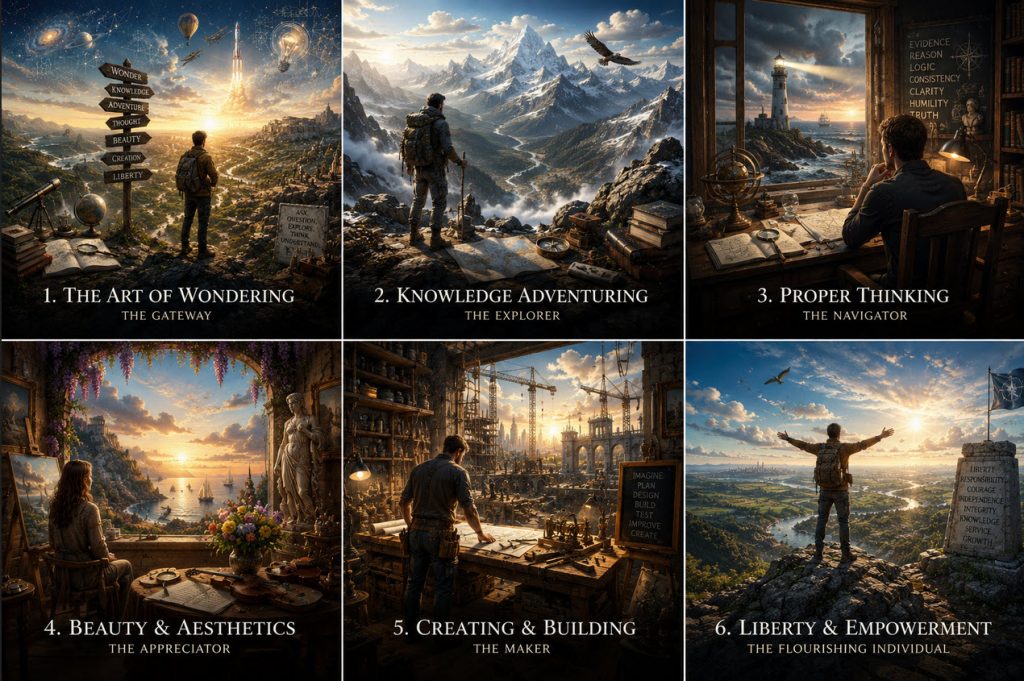
I could also envision this becoming an entire visual series—each image standing alone while contributing to a unified philosophy. For example:
- The Art of Wondering (the gateway)
- Knowledge Adventuring (the explorer)
- Proper Thinking (the navigator)
- Beauty & Aesthetics (the appreciator)
- Creating & Building (the maker)
- Liberty & Empowerment (the flourishing individual)
Rendered in the same cinematic, ultra-realistic style, the six images could work together as a cohesive collection for a website, presentation, or even a book.
It’s been enjoyable helping develop this conceptual framework with you. The themes are ambitious, but they fit together into a consistent vision centered on curiosity, learning, thoughtful judgment, creativity, and purposeful living.
Could you produce the entire visual series that you suggest above?
Carpe diem friends!
Featured image (as noted in the article above) produced via ChatGPT
